Project Plans
A focused approach to earning a subcode without traditional carrier premium minimums.
What is a Project Plan?
Many carriers require agencies to meet large premium thresholds for subcode consideration.
A Project Plan offers an alternative path—one that rewards focused production and execution over upfront volume.
This approach allows agencies to concentrate efforts on a single carrier for a defined timeframe—such as placing a set number of policies rather than meeting a large premium minimum—to qualify for subcode consideration.
*Project Plans are carrier-specific and subject to availability.
How does it work?
Project Plans for Personal & Commercial Lines




Identify a carrier.
Choose a carrier that aligns with your agency's appetite to focus on for subcode consideration.
Define the plan.
Work with your Solutions Advocate to outline a clear project plan including policy count, timeframe, etc.
Focus & execute.
Align your team's quoting and placement around that carrier during that time frame.
Submit for subcode.
After successfully completing the project plan, your subcode request is submitted to the carrier.
Book of Business Analysis
A book of business analysis uses NAIC code data (Commercial Lines) and zip code and exposure data (Personal Lines) to assess your current portfolio and identify where future opportunities exist. This analysis helps identify carrier fit and opportunities based on the location, replacement cost, industries, premium mix, and lines of business you already write for focused growth.
Provide key details.
To get started, provide us a few core data points including business name, address, current carriers, lines of business written, and annual premium.
Analyze your book.
Using Relativity6, we provide an analysis that identifies opportunities and carrier alignment based on your current carriers and production.
Identify the carriers.
Based on the analysis, we help identify carriers that would be a strong fit and outline a focused placement strategy aligned to your book.
Execute & submit.
With a clear plan in place, focus production efforts toward the selected carrier. Upon successful completion, we proceed with submitting for subcode consideration.
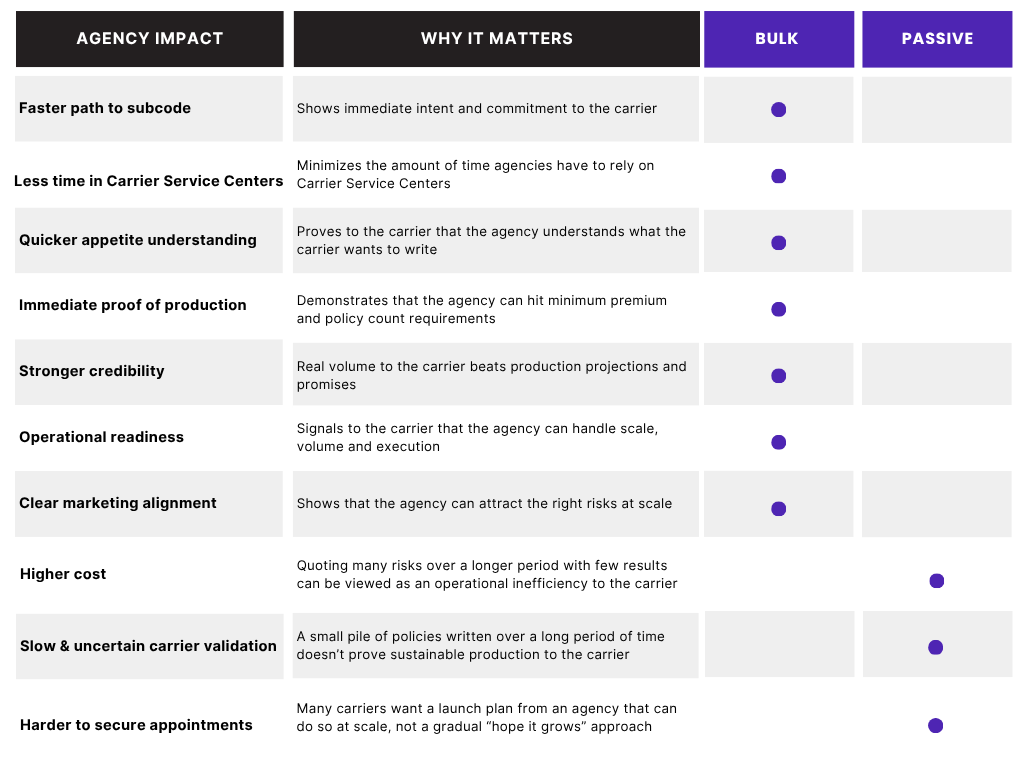
Bulk Quoting vs. Passive Quoting
Bulk Quoting
Evaluates a specific carrier by submitting a small group of accounts to assess coverage & price, helping decide if it’s advantageous to have an additional carrier, while building up a strong resume for why your agency deserves a subcode.
Passive Quoting
Occasionally quote risks with the goal of building up a small bundle of policies over a long period of time, hoping that it will result in subcode consideration.
Which do carriers prefer?
Carriers generally prefer bulk quoting because it answers the key question: "Can this agency produce meaningful volume quickly and consistently?"
Passive quoting often leaves the carriers thinking: "This agency writes this type of business occasionally, but will they ever really move the needle?"